
In June 2026, two members of the Inclusive Prosperity team joined a room full of school food advocates in Montreal. Tolulope Ayeyemi, our Sustainable Agriculture Field Lead, and Dr. Kayzie Sutton, ND, one of our Board Members, attended the Coalition for Healthy School Food's Nourishing Futures Forum, alongside hundreds of educators, food system leaders, and public health professionals from across the country.
At first glance, school lunches and farmland financing might seem like two different conversations. We don't think they are.
The same root system
The Nourishing Futures Forum came together around a simple, urgent idea: with Canada's new National School Food Program and Policy now in motion, this is the moment to shape what school food actually looks like on the ground, not just on paper. That means asking who grows the food, where it comes from, and whether it reflects the communities eating it.
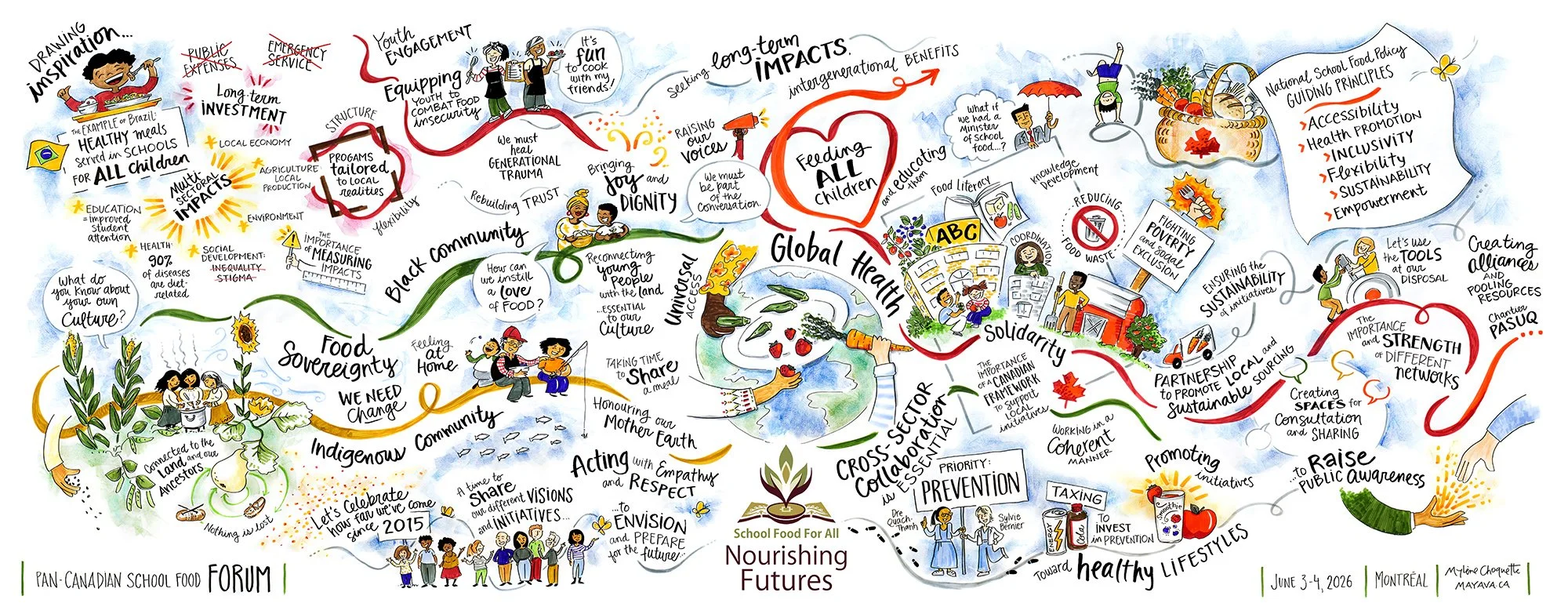
A visual summary of the learnings from the 2026 Nourishing Futures Forum, by artist Mylène Choquette.
Those are questions we ask at Inclusive Prosperity too, just from a different entry point. While this forum spoke about the food that's on school lunch tables, we're working on who gets to own the land that grows the food in the first place.
A school food program that's universal and culturally appropriate needs a supply chain that's diverse and locally rooted to match it. You can't serve culturally relevant meals at scale if the farmers growing culturally relevant crops can't get secure access to land. The two problems, and the two solutions, go hand in hand.
Dr. Sutton put it well in her reflection after the forum:
"My hope is that people leave this conversation feeling empowered to speak up, stay curious, and recognize that each of us has a role to play in creating positive change. Whether we're talking about food, health, land access, or economic opportunity, meaningful progress happens when people ask questions, challenge barriers, and work together. As both a naturopathic doctor and a farmer, I believe that stronger, healthier communities are built when access and opportunity are available to all. I hope this forum sparks new conversations, new partnerships, and meaningful action."
Tolulope brings the same conviction from the other end of the food system. As our Sustainable Agriculture Field Lead, she spends her days working directly with the land, alongside farmers coming through our Farmer Field School. She's also spoken on panels alongside leaders in African Canadian food sovereignty work, because the conversation about who grows our food, and who gets fed by it, is happening at every level right now: from a single farm plot to a national policy table.
Where the African Canadian Farmers Fund fits in
This is where the African Canadian Farmers Fund (ACFF) comes in.
Land access is the single biggest barrier standing between African Canadian farmers and long-term stability. Most start out renting, which means every planting decision is shadowed by the possibility of losing the lease the following season. You can't build soil health over a decade if you don't know whether you'll be on that soil next year. You can't invest in the infrastructure a culturally relevant crop needs, things like season extension for callaloo or okra, if the land underneath it was never really yours to improve.
The ACFF exists to break that cycle. Through a rent-to-own model, farmers build equity in their land year over year rather than handing that value to a landlord indefinitely. Every payment moves a farmer closer to ownership instead of just closer to next month's rent. Over time, this turns a precarious lease into a durable asset, one that can be passed down, borrowed against, or expanded.
Our vision for the ACFF goes beyond helping any one farmer secure a single plot. We want to build a growing footprint of African Canadian-owned farmland across the country, land that stays in community hands for generations rather than cycling through absentee ownership. We see this as patient, relationship-based capital: not a one-time grant, but a long-term financial partnership that treats farmers as the asset builders and community leaders they already are.
Done at scale, this is what closes the loop with programs like the National School Food Program. Culturally appropriate procurement targets only work if there's a stable, expanding base of farmers who can actually supply that food, season after season, at a scale schools and school boards can rely on. Secure land tenure is the infrastructure underneath that promise.
Two ends of the same system
Through our Farmer Field School, new and returning farmers get hands-on training in climate-smart, culturally relevant agriculture, everything from soil management to business planning to navigating the financing landscape most banks were never built for equity-deserving communities to access. Together, the ACFF and the Farmer Field School are upstream of the school lunch trays that could one day carry food grown by the farmers we support: one program builds the land base, the other builds the skills to farm it well.
If the National School Food Program succeeds in getting more culturally appropriate, community-rooted food onto kids' plates, it will need farmers who reflect those communities, with secure enough land tenure to plan five and ten years ahead instead of one season at a time. Because, as Dr. Sutton said, progress happens when people keep asking the questions and keep working together.
